How IP Reputation Affects Proxy Performance
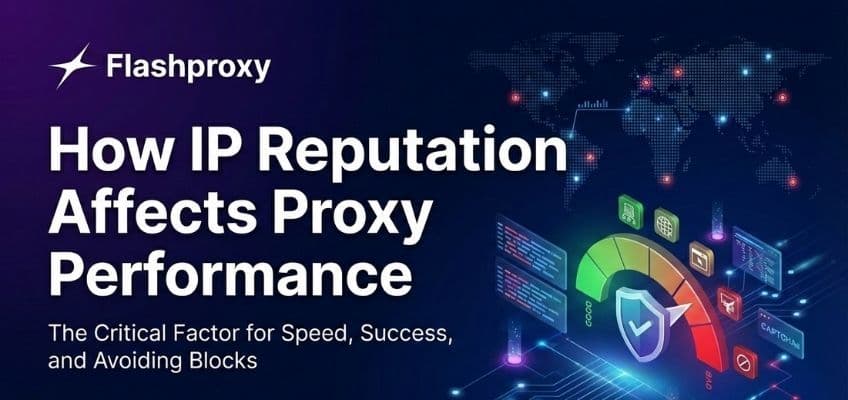
Learn how IP reputation affects proxy performance, success rates, blocks, and CAPTCHAs, and why clean proxy IPs are essential for stability.
Key takeaways
- IP reputation, not just speed or location, determines whether a proxy's requests are accepted or blocked.
- Low-reputation IPs face more blocks, more CAPTCHAs and lower success rates for scraping and account automation.
- Overused datacenter IPs, aggressive traffic patterns and recycled blacklisted IPs are the main causes of bad reputation.
- Residential and ISP proxies generally carry stronger reputation than datacenter proxies, which are easiest to detect.
- Realistic delays, smart rotation, location matching and block-rate monitoring help preserve IP reputation.
When people evaluate proxy performance, they often focus on speed, location, or rotation frequency. One critical factor is frequently overlooked: IP reputation.
Even the fastest proxy will fail if its IP reputation is poor. Modern websites do not only evaluate where traffic comes from. They analyze whether an IP address is trustworthy based on its history and behavior.
In this article, we explain what IP reputation is, how it affects proxy performance, and why using clean proxy IPs is essential for reliable results.
What Is IP Reputation?
IP reputation is a trust score assigned to an IP address based on its past activity across the internet.
Websites and security systems track factors such as request volume, behavioral patterns, failed actions, spam reports, and associations with known proxy or VPN networks. Over time, this information forms an IP reputation score.
IPs with a strong reputation are treated as legitimate users. IPs with a poor reputation are flagged as risky and are more likely to face restrictions.
Why IP Reputation Matters for Proxy Performance
Proxy performance is not just about speed or uptime. The reputation of the proxy IP determines whether your requests are accepted or blocked.
Higher Block Rates
Proxy IPs with a bad reputation are often blocked immediately or restricted after only a few requests. In many cases, websites refuse connections entirely or serve incomplete or misleading data.
This results in failed requests, reduced success rates, and wasted resources. Even large proxy pools do not help if the IPs themselves are already flagged.
More CAPTCHAs and Verification Challenges
Websites rely heavily on IP reputation to decide when to trigger security checks. Low-reputation IPs are far more likely to encounter CAPTCHAs, email verification steps, or advanced protection systems like Cloudflare and Akamai.
These interruptions significantly reduce automation efficiency and make scaling difficult.
Lower Success Rates for Automation
Tasks such as web scraping, social media automation, account management, and ad verification depend heavily on trust signals.
A clean IP reputation allows these activities to run smoothly. A poor IP reputation leads to constant failures, retries, and blocks. This is why proxy IP reputation directly affects proxy success rate.
What Causes a Bad IP Reputation?
Several common factors damage IP reputation over time.
Overused datacenter IPs are one of the biggest issues. Cheap datacenter proxies are often shared by many users and heavily abused for automation. Once detected, these IPs lose trust quickly.
Aggressive traffic patterns also contribute to poor reputation. Sending too many requests in a short period, skipping human-like delays, or repeating failed actions makes IPs appear suspicious.
Another major problem is recycled or blacklisted IPs. Some providers reuse IP addresses with a history of spam, fraud, or abusive behavior. Using these IPs means starting with a damaged reputation from day one.
How Websites Evaluate IP Reputation
Modern websites use sophisticated systems to assess IP trust. These include historical request data, ISP and ASN analysis, behavioral fingerprinting, and third-party proxy detection databases.
Because detection methods continue to improve, IP reputation has become one of the most important factors in proxy performance, especially for protected websites.
Clean Proxy IPs vs Poor-Quality Proxy IPs
Clean proxy IPs have a strong trust history and are less likely to be flagged. They experience fewer blocks, fewer CAPTCHAs, and higher long-term success rates.
Poor-quality IPs are frequently challenged, blocked, or throttled. They require constant troubleshooting and are unreliable for serious projects.
Choosing clean proxy IPs is essential for stable, scalable operations.
Which Proxy Types Have the Best IP Reputation?
Residential proxies generally offer a strong IP reputation because they are assigned by real internet service providers and resemble normal user traffic.
ISP proxies combine the trust of residential IPs with the speed of server-based infrastructure. This makes them especially reliable for high-volume professional use.
Datacenter proxies, while fast, are the easiest to detect. Their IP reputation often declines quickly on protected sites, and they are best suited only for low-security targets.
At Flashproxy, proxy performance starts with IP reputation management.
We carefully source IPs, enforce strict usage limits, and continuously monitor reputation signals. Flagged or overused IPs are removed quickly, and rotation logic is designed to minimize pattern detection.
This approach results in higher success rates, fewer blocks, and stable long-term performance.
A proxy is only as effective as the reputation behind it.
How to Protect Your IP Reputation
Even high-quality proxies require responsible usage.
Using realistic request delays, avoiding aggressive scraping speeds, rotating IPs intelligently, matching proxy locations to target websites, and monitoring block rates all help preserve IP reputation.
When good usage practices are combined with clean proxy IPs, proxy performance improves significantly.
Final Thoughts
If your proxies are slow, blocked, or unreliable, the issue is often not speed or infrastructure. In many cases, it is IP reputation.
Understanding how IP reputation affects proxy performance allows you to choose better proxy types, avoid unnecessary failures, and scale projects more efficiently.
Using clean, well-managed proxy IPs from a trusted provider like Flashproxy gives you a strong foundation for long-term success.