
The True Reason behind Mass Ban to Your Accounts
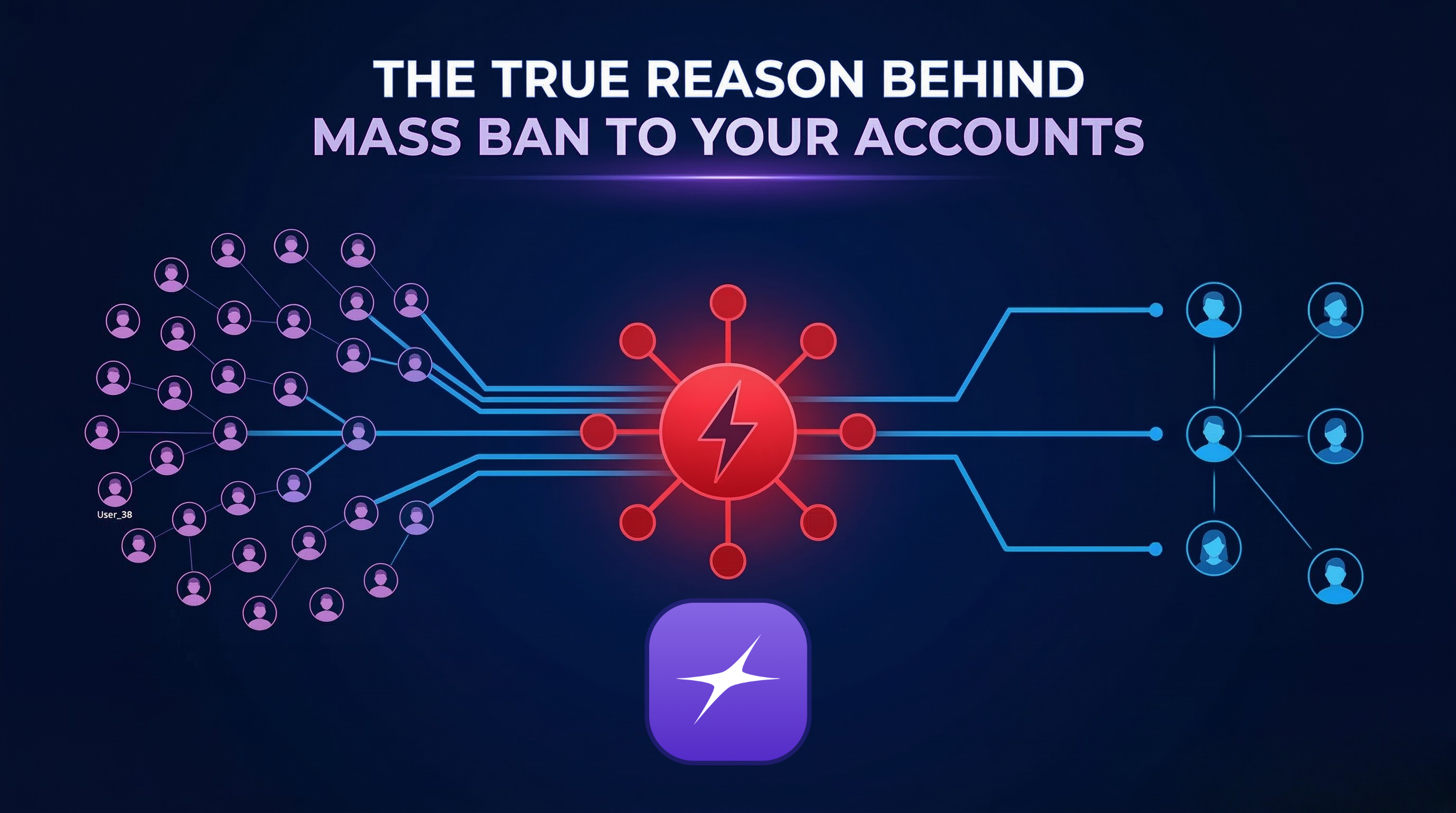
Stop blaming your browser settings for synchronized mass bans. The culprit isn't your setup—it’s your Network DNA. When dozens of isolated profiles drop at once, modern security systems haven't just flagged your actions; they’ve linked your entire operation through Subnet Clustering and Trust-to-Traffic anomalies. If your network signal doesn't mimic a messy, organic residential home, you're a sitting duck for automated termination.
Experiencing a synchronized "batch ban" across dozens of isolated accounts is the ultimate signal that your network reputation has compromised your operation. When profiles are restricted simultaneously, it is rarely a failure of your browser configuration; it is an indication that modern security systems have linked your accounts through shared Network DNA.
Modern security systems prioritize the relationship between a network's behavioral history and the actions performed during a session. If the network signal does not match the expected pattern of a standard user, the entire operation is flagged for review.
By the end of this post, you will understand how to identify the network-level anomalies that lead to account linkage and how to resolve the credibility gap by aligning your technical infrastructure with authentic residential identity.
The Reality of Network-Level Detection
When security layers move beyond simple blacklists, they look for Subnet Clustering and Behavioral Anomalies.
The Impact of Subnet Clustering: A common issue occurs when multiple accounts originate from a narrow range of IP addresses owned by the same commercial provider. Even if the IPs are different, they share a "neighborhood." Systems identify this cluster as a single entity rather than distinct users, leading to the synchronized termination of all accounts within that range.
The Trust-to-Traffic Anomaly: Standard residential connections produce a mix of background traffic—streaming, updates, and routine browsing. When a network connection displays only high-frequency management actions without this "organic noise," it creates a statistical anomaly that triggers automated restrictions.
Establishing Credibility through Subnet Diversity
A "fresh" IP address often lacks the documented history of legitimate behavior required for high-security environments. Stability depends on an Established Residential Reputation.
Residential DNA: Utilizing a pool of 100M+ real consumer nodes ensures that traffic is distributed across millions of unique, non-commercial subnetworks globally. This Subnet Diversity ensures that each account appears as a standalone, unrelated connection. The presence of organic residential traffic provides the necessary cover for technical tasks, making them indistinguishable from routine home-user activity.
Operational Scaling at $0.16/GB
Maintaining account longevity requires frequent engagement and "warming" actions to establish a credible history. At traditional pricing models ($10/GB), performing the high-data-rate tasks necessary to look human is often too expensive to sustain.
The Economics of Stealth: At $0.16/GB, the cost barrier to high-frequency activity is removed. This allow for the high-volume, organic-style browsing necessary to satisfy security audits without depleting operational margins.
Summary: Multi-accounting success is a matter of Believability. If the network layer does not provide sufficient subnet diversity or align with residential behavioral patterns, profile isolation alone is insufficient to prevent synchronized account loss.
Optimal performance is achieved when network reputation and profile isolation work in tandem. FlashProxy integrates with industry-leading anti-detect solutions like MultiLogin to provide a unified, credible identity.